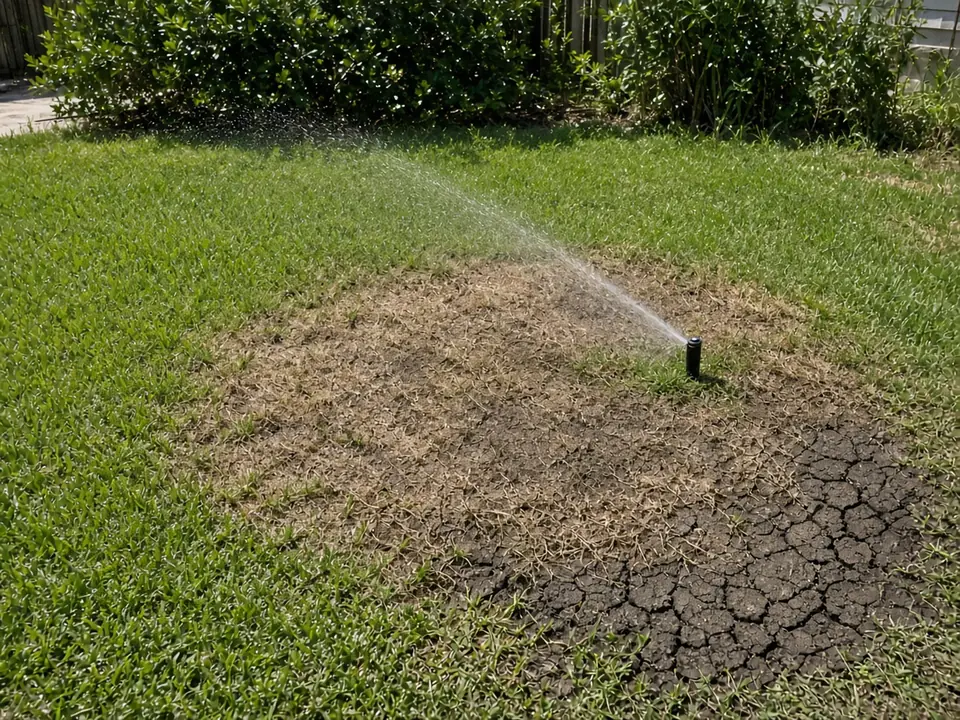
Two kinds of dead zones
A whole zone that won’t turn on is almost always electrical or a valve problem: a cut or corroded wire, a failed solenoid, a valve stuck closed, or a controller output that’s gone bad.
A brown patch inside a working zone is a coverage or water-delivery problem: blocked or mismatched nozzles, heads that have sunk, low pressure from a leak, or water running off the clay before it soaks in.
How we diagnose it
- Run every zone and watch the actual spray pattern and overlap.
- Meter the circuit from the controller to the valve solenoid to find opens and shorts.
- Check pressure and flow on the zone for leaks, kinked lines or a partially open valve.
- Map the dry spots against the head layout to see if coverage reaches head-to-head.
- Check the schedule for run times too long for clay (runoff) or too short for summer.
Is it the sprinkler or the lawn? In Houston summers, chinch bugs and brown patch fungus can look like dry spots. If the soil underneath is moist and the zone covers it, we’ll tell you it’s likely not the irrigation.
Typical fixes
- Splicing or re-running damaged zone wire with waterproof connectors
- Replacing failed solenoids and valve diaphragms
- Raising, adding or relocating heads to restore head-to-head coverage
- Swapping to matched-precipitation nozzles across the zone
- Repairing the leak that’s robbing pressure from the end of the line
- Reprogramming with cycle-and-soak so water stays in the root zone
Common questions
Will running the zone longer fix a dry spot?
Usually not. If water isn’t reaching the spot, extra minutes just overwater the rest of the zone and run off the clay. Fixing coverage is cheaper than paying for the water.
Why did a zone stop after a storm or digging?
Zone wires are often shallow. Fence posts, landscaping, utility work and lightning surges are common causes, and we can locate and repair the break.