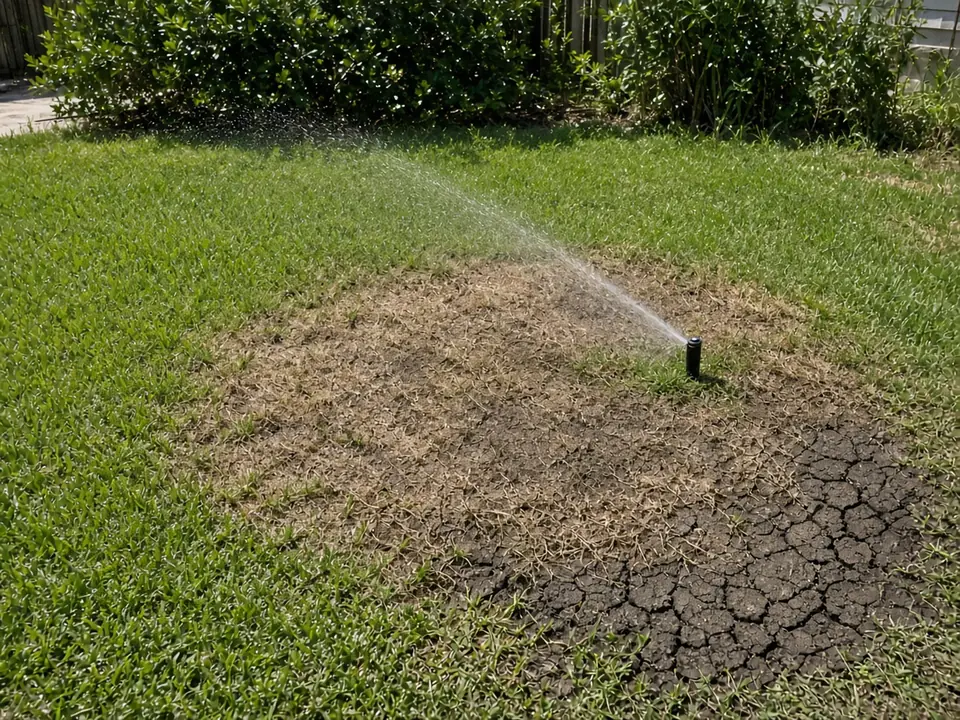
Start with the soil: Houston gumbo clay
Much of Houston sits on dense, expansive clay, the black “gumbo” that sticks to boots when wet and cracks open in dry spells. It holds a lot of water, but takes it in slowly. Spray heads can put down water faster than clay absorbs it, so long cycles run off into the gutter while the root zone stays dry.
Cycle-and-soak: instead of one 20-minute cycle, run a spray zone 2–3 times for 6–8 minutes each, about an hour apart. The water soaks in between cycles instead of running off.
A simple Houston schedule
| Season | How often | Notes |
|---|---|---|
| Summer (June–Sept) | About 2 days a week, deep | Aim for roughly 1 inch per week including rain. Water before sunrise. |
| Spring & fall | About 1 day a week | Cut run times as temperatures drop and rain picks up. |
| Winter (Dec–Feb) | Rarely, or off | Dormant St. Augustine needs little water. Water before a hard freeze, not during. |
These are starting points. Shade, slope, turf type and head type change the right numbers for each zone. A coverage check tells you which zones need more and which need less.
City of Houston watering rules
As of late 2026, the City of Houston has no drought stage in effect, so there are no assigned watering days. The City still asks residents to fix leaks and keep sprinklers from spraying into streets and storm drains.
When the City declares a drought stage under its Drought Contingency Plan, outdoor watering moves to two assigned days per week based on your address, between 7 p.m. and 5 a.m. (voluntary in Stage 1, mandatory in Stage 2). Always check Houston Public Works for the current declaration and your assigned days.
Summer tips that save water and turf
- Water early. Between about 4 and 8 a.m. there’s less evaporation and wind, and leaves dry quickly, which limits fungus.
- Don’t water every day. Shallow daily watering grows shallow roots and invites brown patch and chinch bug damage.
- Fix misting heads. High pressure turns spray into fog that blows away. Pressure-regulated heads and correct nozzles put water on the ground.
- Use a rain sensor. Gulf storms can drop inches in an hour. A sensor skips cycles when it’s already wet.
- Watch the edges. Concrete and brick bake in July. Lawn along driveways and walks often needs a nozzle adjustment, not more minutes for the whole zone.
After a big storm or freeze
Heavy rains and clay movement can tilt or bury heads, and a hard freeze can crack exposed pipe and backflow parts. Run each zone for a minute afterward and look for geysers, puddles and heads that don’t pop up, or ask us to check it.